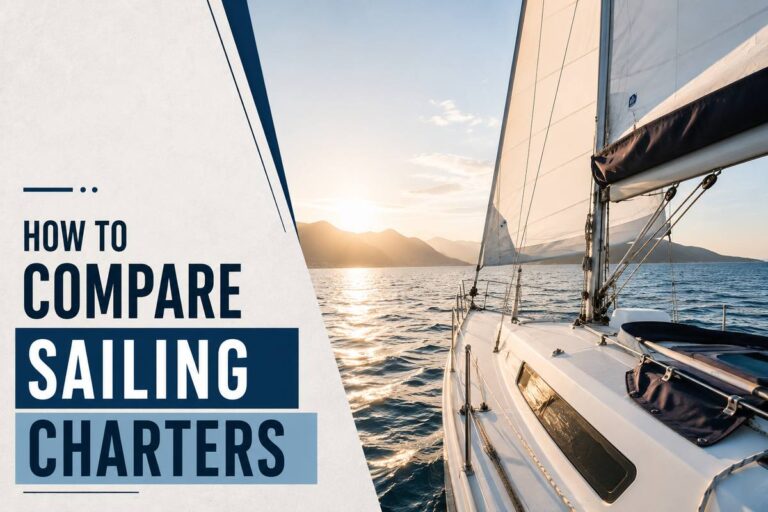
People shop for a boat trip the way they pick a restaurant, by scrolling photos and choosing the one that looks nicest. That works right up until the boat is smaller than it looked online, the captain is not licensed for the size of your group, or the advertised price turns out to be about half of what lands on the final invoice. Learning how to compare sailing charters properly takes very little time and prevents all three outcomes.
This guide covers the checks that separate a real charter operation from a boat owner with a nice website: credentials, legal passenger limits, insurance, what belongs in a fair quote, and the warning signs worth walking away from. The lens here is the provider, not the boat itself. A gorgeous vessel run by a sloppy operation is still a bad booking.
Key takeaways
- The captain’s credential and the vessel’s inspection status set a hard legal ceiling on how many paying passengers can be aboard, so confirm both before you compare prices.
- A U.S. Coast Guard OUPV license, commonly called a six-pack, covers up to six paying passengers on an uninspected vessel, while seven or more passengers require an inspected vessel with a Certificate of Inspection and a Master credential.
- A quote is only comparable once you know what it includes: crew, fuel, dock fees, gratuity, food and drink, and any hourly minimum.
- Ask for the operator’s liability insurance limit and the name of the captain who will actually be at the helm, because a legitimate operation answers both in one sentence.
- Red flags travel in packs. No license number, cash only, vague passenger counts, and no written cancellation policy usually show up together.
What does it actually mean to compare sailing charters?
Comparing sailing charters means evaluating the operator, not just the boat. Two charters can advertise the same vessel length, the same two-hour sail, and prices within a few dollars of each other, while one carries a properly credentialed captain, current commercial insurance, and a written weather policy, and the other carries none of those. Price similarity hides enormous differences in risk and service.
A useful sailing charter comparison works in three passes. First, screen for legitimacy: credentials, insurance, and passenger capacity. Second, screen for fit: private versus shared, harbor versus open ocean, sunset versus midday, group size, mobility needs, and whether children are aboard. Third, and only then, compare price against what is actually included.
Doing those passes in that order matters. If you start with price, you spend your attention on the cheapest quote, and the cheapest quote is frequently cheap because something is missing from it.
Which credentials should a sailing charter provider be able to show you?
A charter operator carrying passengers for hire in U.S. waters needs a credentialed captain, and the credential type depends on the vessel and the passenger count. The U.S. Coast Guard issues these through the National Maritime Center. Any legitimate operator can tell you which credential their captain holds without hesitating, and most will tell you the tonnage rating and route endorsement too.
Ask three questions: what credential does the captain hold, is the vessel inspected or uninspected, and what is the commercial liability limit on the policy? Vague answers to any of the three are meaningful. In practice, operators who run clean books answer these in a sentence because they field the question weekly from corporate and event clients who have to satisfy their own risk teams.
| Credential or document | What it covers | What to ask the operator |
| OUPV, the six-pack license | Up to six paying passengers on an uninspected vessel under 100 gross tons | Does this trip stay within six paying passengers? |
| Master credential (25, 50, or 100 gross tons) | Inspected vessels and larger commercial operations, seven or more passengers | Which tonnage and route endorsement does the captain hold? |
| Certificate of Inspection (COI) | Required for vessels carrying more than six passengers, states passenger limit, route, and minimum crew | May I see the passenger number listed on the COI? |
| Auxiliary sail endorsement | Authorizes operation of sail-powered vessels | Is the sail endorsement current? |
| Commercial liability insurance | Protects passengers in the event of injury or loss | What is the per-occurrence limit, and can you send a certificate? |
How many passengers can a sailing charter legally carry?
Passenger capacity is the single most common source of confusion when people compare sailing charters, and it is not a matter of how many seats fit on the boat. It is a legal ceiling. Under U.S. Coast Guard rules, an uninspected passenger vessel may carry six or fewer passengers for hire, which is the origin of the six-pack nickname for the OUPV license. A professional crew does not count toward that six.
Carrying seven or more paying passengers moves the trip into inspected vessel territory. Small passenger vessels under 46 CFR Subchapter T are less than 100 gross tons and carry more than six but not more than 150 passengers, and they must meet Coast Guard requirements for design, construction, stability, and systems, with a Certificate of Inspection that spells out the passenger limit, the route, and the minimum crew.
The practical consequence for you: if your group is eight people and an operator quotes you a six-passenger boat, one of two things is happening. Either they plan to leave two people on the dock, or they are planning to break a rule. Neither is a good start.
What questions should you ask before booking a sailing charter?
The fastest way to sort providers is a short call with a fixed list of questions. What we see in practice is that the good operators enjoy this conversation and the weak ones try to move you to a booking link. Work through these in order:
- What credential does the captain hold, and will that captain be running my trip?
- Is the vessel inspected, and what passenger number is on the Certificate of Inspection?
- What is the total price with tax, fuel, dock fees, and crew gratuity included?
- Is there an hourly minimum, and what does an extra hour cost?
- Is this a private charter or a shared sail with other parties aboard?
- What is the written policy if wind, fog, or small craft advisories cancel the sail?
- May I bring food and drink aboard, and is there a corkage or cleaning fee?
- How many crew will be aboard, and what are their responsibilities?
- Is the boat accessible for guests with limited mobility, and is there a head aboard?
- Can you send a certificate of insurance before I pay a deposit?
What does a fair sailing charter quote look like?
A fair quote is itemized and total. The number you are given should be the number you pay, with tax and fees visible rather than added at checkout. When buyers tell us a charter felt overpriced afterward, the complaint is rarely the base rate; it is the four line items nobody mentioned on the phone.
Build a like-for-like sheet before comparing. Put the base rate, the hourly minimum, fuel, crew gratuity, dock or launch fees, tax, and any food and beverage charge in separate columns for every operator. A quote that looks noticeably cheaper often loses that advantage once a mandatory gratuity and a fuel surcharge are added back.
| Line item | Typically included? | What to confirm |
| Base charter rate | Yes | Whether the rate is per hour, per trip, or per person |
| Hourly minimum | Varies | Minimum booking length and the cost of an added hour |
| Captain and crew | Usually | How many crew, and whether crew cost is separate |
| Fuel | Usually for sail charters | Whether a surcharge applies for motoring time |
| Gratuity | Often not | Whether gratuity is automatic, suggested, or discretionary |
| Dock, launch, or landing fees | Varies | Which fees appear only on the final invoice |
| Food and beverage | Usually not | Corkage, cleaning fees, and whether provisioning is offered |
How do you compare a private charter against a shared or public sail?
Private and shared sails are different products at different price points, and mixing them up is the most common reason a trip disappoints. A private charter gives you the boat, the schedule, and the route. A shared or public sail sells individual seats on a fixed departure, which lowers the per-person cost and removes most of your control over timing and crowd.
Choose a private sailing charter if the occasion matters, if the group includes children or guests with mobility needs, if you want a specific departure time for sunset, or if you plan to bring your own food and drink. Choose a shared or public sail when you are one or two people, the budget is the deciding factor, and you are comfortable sailing alongside strangers on a set schedule.
| Factor | Private charter | Shared or public sail |
| Cost structure | Flat rate for the boat | Per person, per seat |
| Best group size | Two to the vessel’s legal limit | One or two people |
| Schedule control | You choose the departure window | Fixed departure times |
| Route flexibility | Usually negotiable with the captain | Set route |
| Privacy | Your group only | Shared with other guests |
| Best for | Proposals, birthdays, corporate groups, families | Solo travelers, couples, budget-first trips |
When does a private sailing charter make sense, and how do you compare your options?
When it makes sense
A private charter earns its premium when the occasion, the group, or the timing cannot flex. Proposals and anniversaries need a specific light and no strangers in the photos. Corporate groups need a fixed headcount and an invoice with clear terms. Families with young children need a captain who is comfortable with kids aboard and a schedule that survives a nap. If none of those apply and you simply want to be on the water for two hours, a shared sail delivers most of the experience for less.
How to compare your options
Score every shortlisted operator on the same five things: credential and inspection status, insurance limit, total delivered price, cancellation terms, and recency of reviews that mention the actual captain by name. Weight credentials and cancellation terms most heavily, because those are the two that turn a minor problem into an expensive one. Reviews older than a year tell you little, since captains and boats change hands often in this business.
What results to expect
A well-run charter looks boring from the outside: the boat is ready at the dock, the safety briefing takes three minutes, the captain names the route and the return time before leaving the slip, and the final invoice matches the quote. Expect the captain to adjust the plan for wind and traffic, and expect that to be explained rather than announced. If you booked a sunset sail, expect the departure to be timed backward from sunset, not forward from the top of the hour.
What are the red flags when comparing sailing charter providers?
Some warning signs are obvious, and some only show up if you ask. The reliable pattern is clustering. An operator missing one item on this list is worth a follow-up question, and an operator missing three is worth skipping entirely.
| Green flag | Red flag |
| Names the captain’s credential without being pushed | Deflects credential questions or answers with “we’re fully licensed” |
| Sends a certificate of insurance on request | Cannot produce insurance documentation |
| States a passenger limit that matches the vessel’s status | Offers to squeeze in extra guests for cash |
| Written cancellation and weather policy | Verbal assurance only, or no refund policy at all |
| Itemized quote with tax and fees shown | Round number with fees revealed at the dock |
| Recent reviews naming crew and specific trips | Only old reviews, or reviews with no operational detail |
| Card or invoice payment with a receipt | Cash only, or payment by app to a personal account |
The offer to add extra passengers for cash deserves special attention. An operator willing to exceed a legal passenger limit for your group is telling you exactly how they treat every other rule aboard, including maintenance and safety equipment.
How much does the harbor itself change the sailing experience?
Where you sail changes the trip more than the boat does, so factor the venue into any sailing charter comparison. Newport Harbor is a good example of how much local conditions matter. The City of Newport Beach reports the harbor is home to more than 9,000 recreational vessels, and it stretches more than three miles from the jetties at the entrance into the Back Bay, with a 5 mph speed limit and a no-wake rule enforced from the entrance throughout the harbor.
That density has real effects on your sail. Harbor cruising is calm, scenic, and easy on anyone prone to seasickness, but it is slow by design. Getting outside the jetties for actual sailing in ocean swell takes time out of a two-hour booking, so ask any operator how much of your window is spent transiting. Operators based in the harbor, such as The Newport Beach Sailing Charters, can tell you what the wind typically does in your booked time slot, which is a question worth asking anywhere you sail.
What should the safety briefing tell you about the operator?
The pre-departure briefing is the cheapest quality signal you will get, and it happens before you leave the dock. A professional crew shows you where the life jackets are stowed, points out the throwable device, explains what to do if someone goes in the water, and tells you where to stand and where not to stand when the boom moves. If nobody mentions any of that, you have learned something about the operation.
In its 2024 Recreational Boating Statistics, the U.S. Coast Guard reported that among drowning victims whose life jacket use was known, 87 percent were not wearing one.
Those figures describe recreational boating rather than licensed charters, and that gap is the point. Credentialed captains and inspected vessels exist precisely because carrying paying passengers demands a higher standard than a Saturday on your own boat.
How do you compare cancellation, weather, and refund policies?
Weather policies are where charter comparisons get decided, because coastal sailing gets cancelled. Ask for the policy in writing before you pay, and read for three specifics: who decides a trip is unsafe, what the refund or reschedule window looks like, and how far in advance you can cancel for your own reasons without losing the deposit.
Choose the operator with a captain’s-discretion weather clause and a full refund or free reschedule if the captain cancels. Choose against any operator whose policy is silent on captain-initiated cancellations, because that silence usually resolves in their favor. A short non-refundable window close to the sail date is common; a deposit that is non-refundable from the moment of booking is not.
Also ask what happens to your booking if the boat has a mechanical problem. Operators with more than one vessel can often move you to a comparable boat the same day, while a single-boat operation can only offer a reschedule. Neither is wrong, but you should know which you are buying.
What do buyers most often get wrong when comparing sailing charters?
The most frequent mistake is comparing hourly rates across trips that are not the same trip. A two-hour harbor cruise on a 40-foot boat and a two-hour ocean sail on a 50-foot boat with two crew are different products, and the cheaper hourly rate belongs to the smaller experience roughly every time.
The second mistake is booking based on photos. Charter photography is often shot on the best day of the year with a professional crew and no other traffic in the frame. Ask instead for a recent photo of the actual boat, or check reviews for images guests posted themselves.
The third is underestimating group logistics. Boarding twelve people, seating them, and running a head takes real space. If your group is close to a vessel’s legal limit, the trip will feel tight even when it is perfectly legal. When people tell us a charter felt cramped, the booking was usually at ninety percent of capacity.
Frequently Asked Questions
Do I need to tip the captain and crew on a sailing charter?
Gratuity is customary in U.S. charter service and is often suggested at a percentage of the base rate, but practice varies by operator. Ask whether gratuity is automatically added, suggested, or left entirely to you, and get the answer before you compare quotes.
How far in advance should I book a sailing charter?
Book further ahead for sunset slots, weekends, holidays, and peak summer weeks, since those sell out first at most operations. Weekday daytime sails are usually available with much less notice. If your date is fixed, such as an anniversary or a proposal, treat the booking as time-sensitive.
Is a bigger boat always better for a sailing charter?
No. Larger vessels are more stable and carry more people, but they also cost more, may require a larger crew, and can feel oversized for four guests. Match the boat to the group, and remember that a boat’s legal passenger limit is a ceiling, not a comfortable target.
Can I bring my own food and drink aboard?
Many private charters allow it and some provide provisioning for a fee. Confirm corkage rules, glassware restrictions, and cleaning fees in advance. Alcohol policy is set by the operator and the captain, and the captain’s decision on the water is final.
What happens if someone in my group gets seasick?
Harbor sails and calm-weather cruises rarely trigger seasickness, while ocean sails in swell can. Tell the operator during booking if someone is prone to it, ask whether the route can stay inside protected water, and plan medication timing in advance rather than at the dock.
How do I verify a captain’s license is real?
Ask for the captain’s full name and credential type, then confirm the operation’s licensing directly with the operator in writing before you pay. Reputable operators put this in an email without being asked, and reluctance to do so is itself an answer.
Where should you go from here?
Comparing charters well is mostly a matter of asking a handful of specific questions in the right order and refusing to shortcut the credential check.
Read more guides like this one to sharpen the rest of your buying decisions before you spend the money.