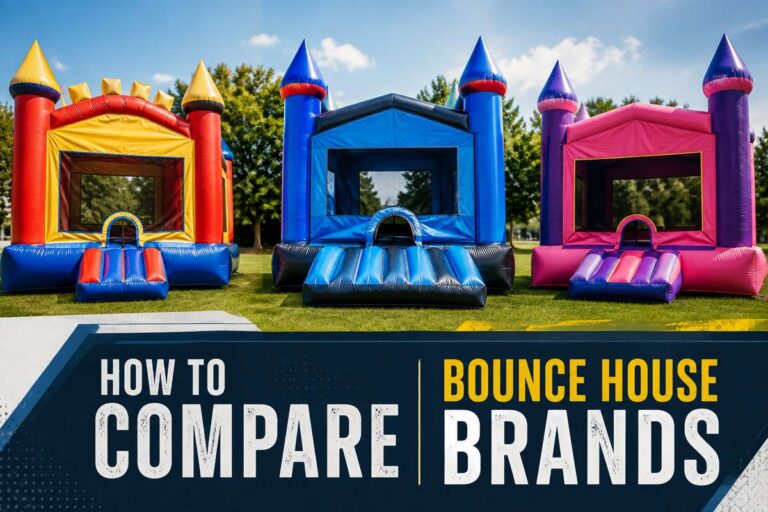
Most people compare bounce house brands the way they compare hotel rooms: photos, price, and a star rating. That works fine when the worst outcome is a lumpy mattress. It works poorly when the product is a heavy inflatable structure holding a yard full of children. Learning how to compare bounce house brands means evaluating the company behind the product, not just the product page.
Brand accountability carries unusual weight in this category. This guide covers the brand-level signals that actually predict outcomes: certification claims you can verify, material specs stated in real numbers, warranty language that matches how you will use the unit, and a support record you can check without taking anyone’s word for it.
Key takeaways
- A bounce house brand that cannot name the ASTM standard its units are built to, including the edition year, has not answered the most basic manufacturing question a buyer can ask.
- Commercial inflatables use PVC vinyl rated by weight per square yard; residential units use lighter oxford or nylon rated in denier, and the two ratings are not interchangeable.
- Warranty terms function as a manufacturer’s own risk estimate, and coverage written for occasional backyard use is not coverage written for a rental season.
- State rules differ sharply: some states regulate inflatables as amusement rides with insurance and inspection requirements, and others do not inspect them at all.
- Brand permanence matters, because a warranty is only as durable as the company that printed it.
What actually separates one bounce house brand from another?
Bounce house brands differ far less in appearance than in accountability. Two units can share the same theme, the same 13-foot footprint, and nearly the same product photo while being built to different material specs, backed by different warranty terms, and supported by companies with very different track records. Appearance is the one variable that copies easily. Everything behind it does not.
When you compare bounce house brands, four factors carry most of the predictive weight: verifiable safety standard compliance, published material specifications, warranty terms written for your actual usage, and a documented support history. A brand that performs well on all four is usually manufacturing to a spec and expecting claims. A brand that performs well only on price is usually a reseller with limited control over what arrives in the box.
The practical test is short. Ask any brand three specific questions before buying: which ASTM edition the unit is built to, the vinyl weight in ounces per square yard, and what the warranty excludes. Vague answers to specific questions are themselves an answer, and in our experience they are the single most reliable early warning a buyer gets.
Which safety certifications should a bounce house brand be able to prove?
A credible bounce house brand can name the standard its commercial units are built to and the edition year attached to it. ASTM International’s F2374 is the governing practice for commercial inflatable amusement devices, covering design, manufacture, installation, operation, maintenance, inspection, training, and major modification. It was originally approved in 2004, has been revised repeatedly, and the current edition is published as F2374-24.
The standard is not decorative. ASTM’s own summary of the 2017 revision notes new requirements for anchoring system design, use of impact attenuation material at entrance and exit areas, and expanded operations language emphasizing trained attendants supervising patrons. A brand advertising compliance with a decade-old edition is advertising compliance with a weaker document, which is why the edition year matters as much as the standard number.
Home-use inflatables sit under a separate standard. ASTM F2729 is the consumer safety specification for inflatable devices marketed directly to consumers for private home use by children, and F2374 explicitly excludes those products from its scope. A brand citing F2374 on a backyard toy, or citing nothing at all on a unit it markets to rental operators, is either careless with language or counting on buyers not to check. Fire performance is a third question again: NFPA 701 covers flame propagation test methods for textiles and films, and commercial-grade vinyl is normally specified to meet it.
How do you compare bounce house brands on materials and construction?
Material specs separate bounce house brands quickly, because the numbers are either published or they are not. Commercial inflatables are built from PVC vinyl rated by weight per square yard. Residential units use woven oxford or nylon rated in denier. The point is not the number itself but whether the brand publishes one at all.
Denier and ounce weight measure different things and are not interchangeable, so a brand that blurs the two is worth a second look. Oxford fabric is lighter, cheaper, and easier to carry. PVC vinyl is heavier, fully waterproof, and better suited to repeated setup, teardown, and sun exposure.
Construction detail matters as much as the fabric itself. Look for stated seam construction, reinforced stress points, and anchoring hardware specifications rather than adjectives like heavy-duty or premium. What we see in practice is that units rarely fail in the middle of a wall. They fail at stitch lines, anchor points, and blower tubes, which is exactly where a brand under cost pressure tends to cut.
| Specification | Commercial PVC vinyl | Residential oxford or nylon |
| Waterproofing | Fully waterproof | Water resistant only when coated |
| Governing ASTM standard | F2374 (commercial) | F2729 (home use) |
| Best suited to | Rental fleets and frequent use | Occasional backyard use |
What does a bounce house brand’s warranty really tell you?
A warranty is the closest thing a buyer gets to a manufacturer’s own risk estimate on its product. A brand that expects claims writes short coverage with wide exclusions. A brand that expects its units to survive writes longer coverage and publishes the terms where buyers can read them before paying.
Read three things in any warranty before you compare prices. First, the base term and whether registration extends it. Second, the definition of misuse, since hard-surface setup without a tarp, improper storage, and normal wear are the exclusions that void most claims. Third, whether the blower is covered on the same term as the inflatable or carries separate coverage, because blowers and inflatables fail on different schedules.
Terms vary widely across the market, and the good news is that they are usually published. Hero Kiddo, a Southern California-based inflatables company, lists a 90-day manufacturer warranty that extends to a full year from the date of purchase when the product is registered online, and states plainly in its policy that using a unit on a hard surface without a tarp counts as improper usage. Whether or not that structure fits your use case, the published detail is the point. A brand that will not put its exclusions in writing before the sale has already shown you how the claim conversation will go.
| What to check | Weak signal | Strong signal |
| Base term | Under 90 days on a unit marketed for rental use | Multi-year term stated in writing |
| Registration | Required, with no stated benefit | Extends coverage, with published terms |
| Exclusions | Not available before purchase | Listed in full and readable pre-sale |
| Blower coverage | Not addressed anywhere | Stated separately with its own term |
| Claim process | Web form only, no phone or address | Named service department and physical address |
How do the main types of bounce house brands compare?
Bounce house brands fall into four rough business models, and the model predicts a great deal about support, spec control, and what happens when something goes wrong. Comparing the model is often more useful than comparing two individual units, because the model determines whether anyone is accountable after the box is opened.
| Brand type | What it is | Best for | Main trade-off |
| Domestic commercial brand | Designs and specs its own units, holds US inventory, runs its own support | Rental operators and heavy home users | Higher upfront cost |
| Overseas factory direct | Buy straight from the manufacturer, often with custom options | Large fleet buys with technical staff | Long lead times, hard claim recovery |
| Big-box consumer brand | Mass-market residential units sold through retail | Occasional family backyard use | Lighter fabric, short coverage |
| Marketplace reseller | Unbranded or white-label listings with no fixed manufacturer | Lowest possible entry price | No spec control, no traceability |
When it makes sense to pay more for a bounce house brand
Paying more for a bounce house brand makes sense when the unit will be set up and taken down repeatedly, transported between sites, exposed to sun for full days, or used to generate revenue. Under those conditions, commercial vinyl weight, reinforced stress points, and a warranty that survives real use are the difference between an asset and a disposable. Paying more makes far less sense for a unit that will inflate a handful of times a year on the same patch of grass.
How to compare your options side by side
Build a short spreadsheet before you shortlist. List each brand’s stated ASTM edition, vinyl weight or denier, unit weight, maximum user count and weight, base warranty term, registration requirement, published exclusions, blower coverage, and whether a phone number and physical address are listed. Any blank cell is a finding, not a gap. In practice, a few brands fill the sheet, and most do not, which makes the shortlist obvious before you compare prices.
What results to expect from a careful comparison
A careful brand comparison rarely produces the cheapest purchase, and it is not supposed to. What it produces is a predictable one: known coverage, a reachable support contact, replacement parts that exist, and documentation you can hand to an inspector or an insurer. Buyers who run this process report far fewer surprises in year two, which is when material and seam quality actually start to show. Buyers who skip it usually discover the gaps at the worst possible moment, mid-season and mid-event.
What online red flags signal a bounce house brand you should skip?
Online red flags for a bounce house brand are usually about what is missing rather than what is claimed. Marketing copy is cheap to write. Traceability, documentation, and a physical business presence are not. Seven signals are worth treating as disqualifying.
- No ASTM edition year listed anywhere on the product page or in the manual, only the phrase commercial grade.
- No vinyl weight or denier published, with durability described only in adjectives.
- No physical address or phone number, only a contact form and a generic email inbox.
- Warranty terms that appear only after checkout, or a warranty page that will not load.
- Missing manufacturer name, model number, or production date code on the unit label, which makes recall lookup impossible.
- Pricing far below every comparable unit on the market with no explanation of what was removed to get there.
- Reviews that are numerous, recent, and uniformly five stars, with no substantive complaints and no visible responses from the seller.
Slow pre-sale communication belongs on the same list. A brand that is slow to answer a specific spec question before it has your money is unlikely to move faster once it has your money.
How should rental operators compare bounce house brands differently than families?
Rental operators and families are buying different products under the same category name, so they should weigh the comparison differently. An operator is buying an income-producing asset that must survive daily handling, pass inspection, and stay insurable. A family is buying occasional entertainment that must be safe, storable, and easy for two adults to move.
Choose a commercial-grade brand if the unit will run more than a handful of times a year, will be transported between sites, will be used at public or paid events, or will be set up on surfaces other than soft grass. Commercial vinyl weight, documented ASTM compliance, and available replacement parts are load-bearing requirements in that scenario, not upgrades.
Choose a residential-grade brand when use is genuinely occasional, storage space is limited, the setup surface is a private lawn, and no one is charging admission. Buying commercial weight for a handful of uses a year mainly buys you a heavier unit to carry and store.
Choose neither, and keep shopping, when a brand cannot produce a warranty document, a standards claim with an edition year, and a material spec before purchase. That combination is the minimum bar for both buyer types, and it is not a negotiating position.
What do buyers tell us they wish they had checked first?
Two things come up more than any others: regulation and permanence. Buyers who intended to rent out their units are routinely surprised that inflatables are regulated as amusement rides in many states, with insurance minimums and inspection requirements attached. Requirements vary sharply by jurisdiction. Texas classifies inflatables as Class B amusement rides subject to annual inspection and liability insurance, while California’s amusement ride program does not inspect inflatables at all.
The permanence problem is less obvious and more expensive. When the U.S. Consumer Product Safety Commission announced a recall of about 2,600 Sportcraft inflatable bounce houses in 2007 over a fan housing that could break apart during use, the remedy was a free replacement fan. The recall notice was later revised: the firm went out of business, no remedy remained available, and owners were told to discard the product. A warranty is only as durable as the company printing it.
Safety context is worth keeping in view while comparing brands. CPSC’s consumer alert on inflatable amusements estimated more than 18,000 bounce house injuries treated in emergency departments in 2018. Most of those incidents trace to anchoring, weather, supervision, and overloading rather than manufacturing defects, which is precisely why a brand that documents anchoring requirements, weather shutdown thresholds, and capacity limits is worth more than a brand that documents none of them.
What terms should you understand before comparing bounce house brands?
A handful of terms do most of the work in this category, and brands rely on buyers not knowing them. Learning the following five makes spec sheets readable and marketing copy much easier to discount.
PVC vinyl weight. The weight of the coated fabric in ounces per square yard. Higher weight generally means better puncture and UV resistance and a heavier unit to carry.
Denier (D). A yarn thickness rating used for oxford and nylon fabric, not interchangeable with ounce weight
ASTM F2374. The standard practice governing design, manufacture, operation, and maintenance of commercial inflatable amusement devices. The edition year, such as F2374-24, indicates which version of the requirements applies.
ASTM F2729. The consumer safety specification covering inflatable play devices marketed to consumers for private home use by children. It is a different standard with different requirements than F2374.
NFPA 701. The National Fire Protection Association’s standard methods of fire tests for flame propagation of textiles and films, commonly referenced in commercial inflatable material specs.
Frequently asked questions
Is a commercial bounce house brand always the safer choice?
Not automatically. Commercial construction generally means heavier vinyl and stronger anchoring, but safety outcomes depend heavily on setup, anchoring, weather monitoring, and supervision. A well-documented commercial unit installed incorrectly is more dangerous than a residential unit used as directed on a calm day.
How can I verify a bounce house brand’s safety claims myself?
Ask for the ASTM edition year in writing, request the owner’s manual before purchase, and check the unit label for manufacturer name, address, model number, and production date code. Those identifiers are what make a CPSC recall lookup possible. A brand that cannot supply them has not made a verifiable claim.
Does a higher price mean a better bounce house brand?
Price correlates with material weight and warranty length, but it does not guarantee either. Compare the published specs and coverage rather than the price tag, since two units at the same price can differ substantially in vinyl weight and warranty term.
What warranty length should I expect on a commercial bounce house?
Expect published terms rather than a single industry number, since coverage varies by manufacturer and by whether the unit is registered. Compare the base term, the registration extension, the exclusions list, and the separate blower coverage across at least three brands before deciding.
Do I need insurance or an inspection to rent out a bounce house?
In many states, yes. Texas treats inflatables as Class B amusement rides with annual inspection and liability insurance requirements, while other states inspect less or not at all. Check your state’s amusement ride program before buying, because the requirement attaches to you as the operator rather than to the brand.
So how do you make the final call between bounce house brands?
Pick the brand that answers specific questions with specific answers. When you compare bounce house brands on stated ASTM edition, published material weight, written warranty terms with visible exclusions, and a reachable support contact, the field narrows fast, and the decision usually makes itself. Price is the last filter, not the first.
Read more guides like this one to keep sharpening how you evaluate equipment before you spend.